Batch Ascent.
The sales team's admissions app: who joined which batch, what they owe, and how each sales exec is doing against target.
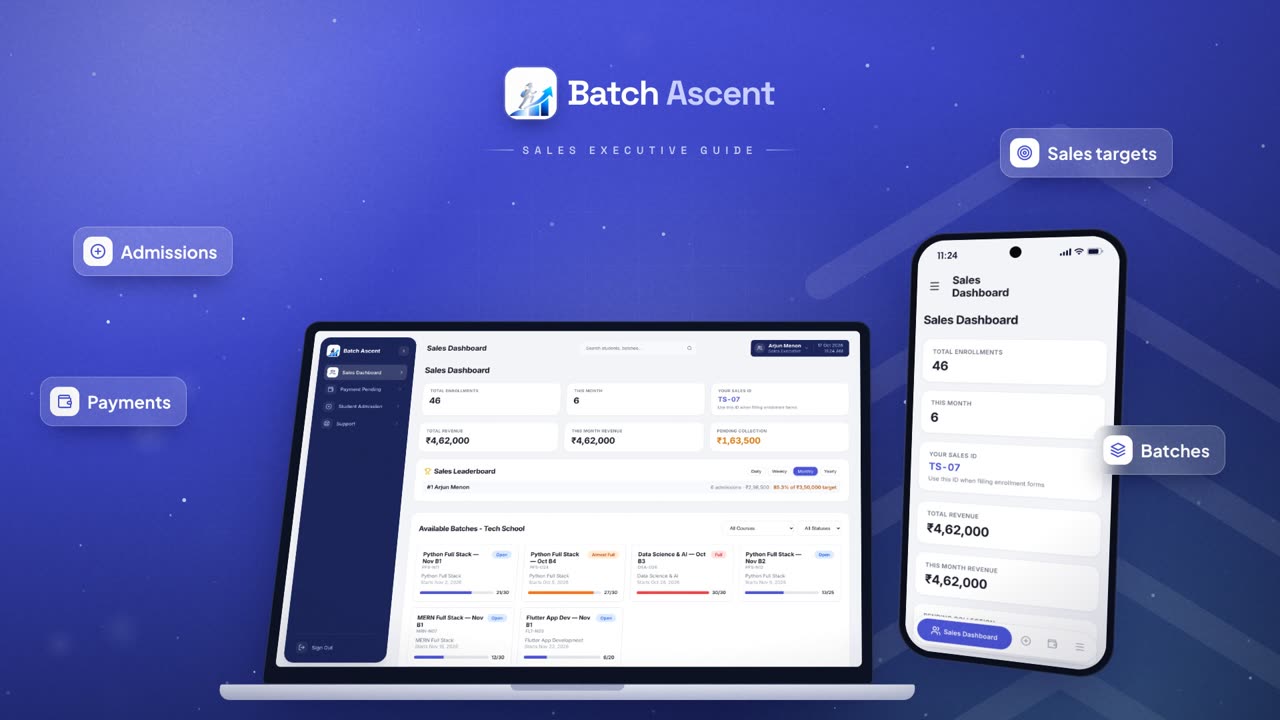
Sales uses it every day to admit students and follow payments. Business Heads see the same numbers in the SHO App dashboard.
- Sales executives: admissions, payments and their own targets
- Sales leads, heads and management: team targets, transfers and collections
- Business Heads: admissions and payment status per school, through the SHO App
From lead to seat,
and every rupee after.
Admissions
Admission form with batch selection and a submit lock against duplicates.
Payments
Full, advance, partial and EMI payments, with a ledger of every transaction.
Targets
Monthly sales targets per exec, by amount and by admissions.
Batch transfers
Transfer requests with the full batch history of each student.
Notices and support
Notices, push notifications and support tickets.
Exports
Excel and PDF exports with xlsx and jsPDF.
Counted from the code and git history.
What took the most thought.
Moving off Supabase
V1 ran on Supabase. I rebuilt it as 22 MongoDB collections and mounted it inside the existing backend at /ba/api, so three apps now run on one server and one database.
No duplicate admissions
A submit lock stops the same admission from being saved twice.
A payment ledger
Every payment, advance, partial or EMI, is stored as its own transaction, so balances can always be traced back.
Sales data mirror
A copy of sales data syncs to Supabase every hour and is backed up every night.
- Frontend
- React 19, Vite 8, TypeScript, React Router, Recharts
- Backend
- Shared Express server, mounted at /ba/api
- Database
- MongoDB Atlas (V2), Supabase (V1, now a mirror)
- Other
- xlsx and jsPDF exports, Web Push
- Hosting
- Vercel (frontend), Render (backend)
Three apps, one backend.
The SHO App, HACA LMS and Batch Ascent run on the same Express server and the same MongoDB database, so there is one backend to run instead of three. Together the three apps have about 700 daily active users.
- Server
- One Express server on Render serves /api (SHO App and LMS) and /ba/api (Batch Ascent)
- Database
- One MongoDB Atlas database shared by all three apps
- Frontends
- Each app is its own Vercel project
- Integrations
- Bunny Storage and Stream, Resend email, Web Push, Google Business Profile and Sheets APIs, Gemini, AWS S3 SDK, Puppeteer for PDFs
Rebuilt it as V2.
I moved Batch Ascent from Supabase to MongoDB and into the shared backend, and built the Business Head dashboard that reads its data.
Used at HACA.
Batch Ascent is for the HACA sales team, so it opens to a staff login.
Open batchascent.harisandcoacademy.com